

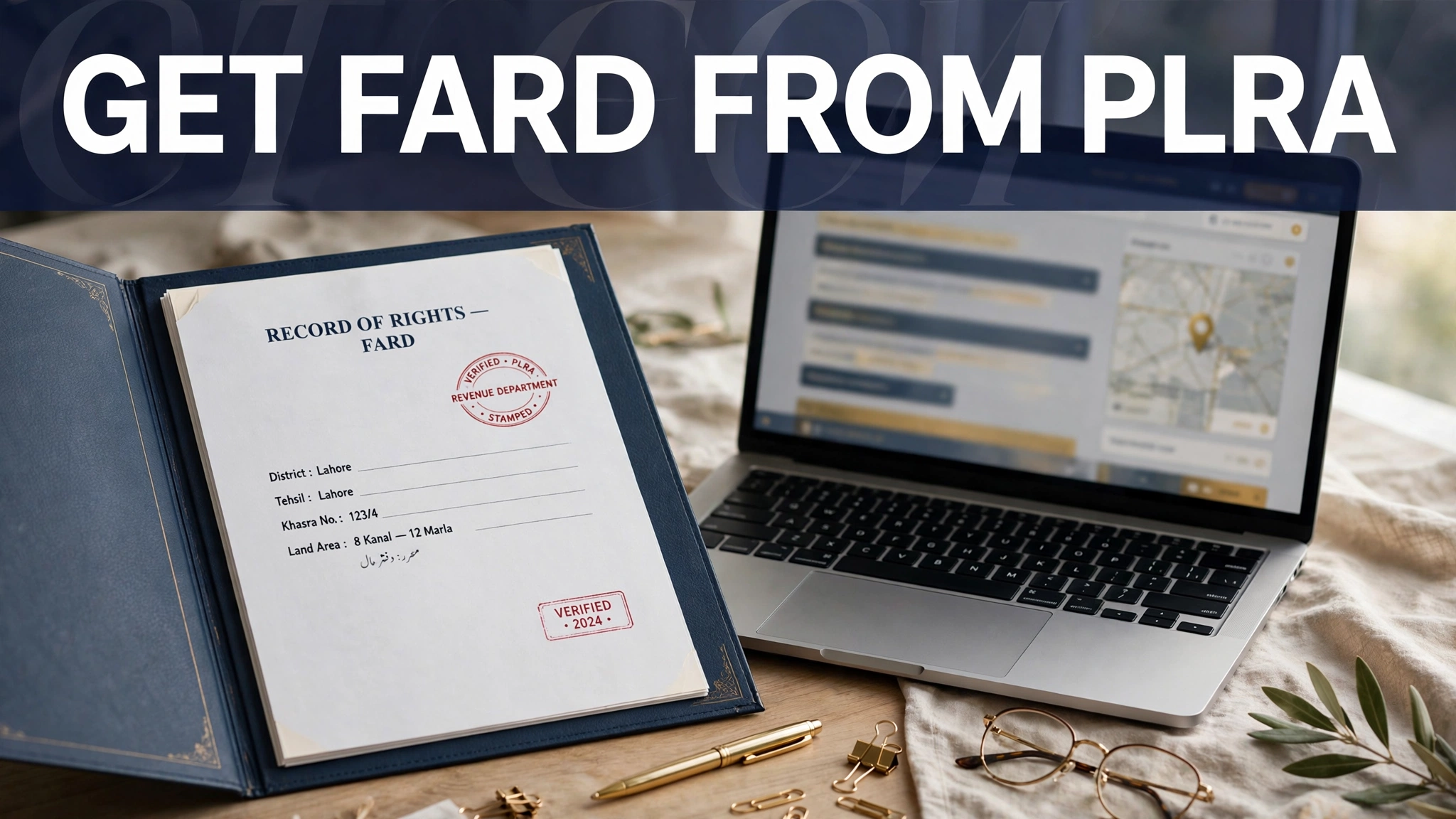
How to Get a Fard from PLRA: Online and at the ARC
Getting a Fard from PLRA is one of the first things you should do before any property deal in Punjab. The Fard is the official ownership record of a piece of land, issued by the Punjab Land Records Authority (PLRA). Whether you need it to confirm your own ownership, to check a property before buying, or as a required document for a sale, registry, or court matter, you have two official routes: the online route through the PLRA portal, and the in-person route at your nearest Arazi Record Centre (ARC). This guide walks you through both, so you can pick the one that fits your situation.
What a Fard Is (in 60 Seconds)
A Fard is an official document drawn from the government’s digitized land records. It shows who owns a property, how much land they own, and how it is identified in the revenue record — through the Khewat number (owners and their shares), the Khatooni number (possession), and the Khasra number (the survey number that places the land on the record map). If you are buying, the Fard answers the most important question first: is the person selling you this land actually its recorded owner?
Do not confuse the Fard with the Registry or the Intiqal. If you are unclear on the distinction, read our explainer on the difference between Fard, Registry, and Intiqal before you go further — the three documents do different jobs, and a deal needs the right ones at the right stage.
Route 1: Get Your Fard Online Through the PLRA Portal
The fastest way to get a Fard for your personal records is through PLRA’s official portal at punjab-zameen.gov.pk. Here is the process:
- Open the PLRA portal. Go to punjab-zameen.gov.pk and look for the online Fard option on the homepage.
- Enter your CNIC. You will be asked for your CNIC, passport, POC, or NICOP number. A verification code is sent to your registered mobile number — enter it to continue.
- Select the property location. Enter the district, tehsil, and mouza (village or revenue area) where the property is located.
- Enter the land details. Provide the Khewat, Khatooni, or Khasra number of the land. If you do not have these handy, our guide on the Khasra number explains how each identifier works.
- State the purpose. The online Fard is issued for personal record-keeping — that is the purpose you select. Download the Fard once it is generated.

Important limitation: the online Fard works for checking your own records, but it is generally not accepted as a certified document for legal transactions. If you need the Fard for a sale, a registry, a bank loan, or a court matter, you need a certified Fard with biometric verification — and that means visiting an ARC.
Route 2: Get a Certified Fard at the Arazi Record Centre (ARC)
The Arazi Record Centre is the official office where certified copies of the Fard are issued for your district or tehsil. Here is what to expect:
- Find your nearest ARC. Check the PLRA website for the ARC serving your district or tehsil. Go to the one that covers the area where the land is located.
- Bring your original CNIC. This is the one document you must carry. You do not necessarily need to remember the Khewat or Khasra number — the officer can pull up your record using your CNIC.
- Take a token and apply. Give the officer your name, your father’s or husband’s name, and the land details you have. State the purpose of the Fard (sale, transfer, court case, or loan application).
- Complete biometric verification. Your thumb impression and photograph will be taken to confirm your identity against the record.
- Pay the fee and get a receipt. A fee challan is issued; the fee is paid per the official schedule at the counter or the designated bank branch, and you receive a receipt. Always collect and keep the receipt.
- Collect your printed Fard. Once the details are verified in the Land Record Management System, the certified Fard is printed and handed to you.

Which Route Should You Use?
Use the online route when you want a quick look at your own land record — to check details before a decision, to confirm something you were told, or to keep a copy for your files. Use the ARC route when a certified document is required: selling or buying land, registering a transfer, applying for a loan against the property, or producing the Fard in a legal matter. When in doubt, the ARC-issued certified copy is the safer document.
How to Use the Fard to Verify a Property Before Buying
Getting the Fard is only half the job — reading it correctly is the other half. Before you pay any token money or sign a bayana, check these four things against what the seller has told you:
- Owner name vs. seller. The name on the Fard must match the person selling. If a different name appears, ask why — and do not proceed until you have a verified answer.
- Area and identity of the land. The Khasra number, Khewat number, and area on the Fard must match the actual plot or property you are being shown. Visit the land and compare.
- Shares and possession. Check how many owners are listed and what share each holds. If several co-owners exist, all of them must agree to the deal.
- Red flags. Any indication of a court stay, an incomplete mutation, or an existing mortgage against the property is a signal to stop and investigate before committing money.

What If the Fard Shows an Error?
It happens: a name spelled wrong, an area that does not match, a share that looks off. Do not ignore it, and do not pay for the property until it is fixed — an error in the Fard becomes your problem the moment you buy. The record can be corrected through the official correction process. Read our guide on Fard Badar to understand how land record errors get corrected in Punjab, and take the correction up with the ARC and the revenue authorities before you sign anything.
Practical Tips Before You Go
- Check computerization first. If your district or tehsil’s record is not yet fully digitized, the online route may not work for it — the ARC remains your fallback.
- Carry the original CNIC. Photocopies alone do not work for biometric verification at the ARC.
- Keep the fee receipt. Every payment at the ARC should produce an official receipt. Do not pay anything without one.
- Overseas Pakistanis. If you cannot visit in person, a trusted person with a valid power of attorney can apply on your behalf for the ARC route.
Bottom Line
Getting a Fard from PLRA is straightforward: use the online portal at punjab-zameen.gov.pk for a quick personal-record copy, or visit your nearest Arazi Record Centre with your original CNIC for a certified copy with biometric verification. Certified copies are what sales, registries, loans, and courts require. Read the Fard line by line before any payment, and if anything in it does not match what the seller claims, stop and verify — that one habit protects more money than any other step in a property deal.
Note: This article is general information, not legal advice. Land record procedures can change, so confirm the current process on the PLRA portal or at your ARC before acting.
1 Comment
Pingback: Fard-e-Bai vs Fard-e-Malkiat: What's the Difference?