

What Is the Difference Between Token Money and Bayana in Pakistan?
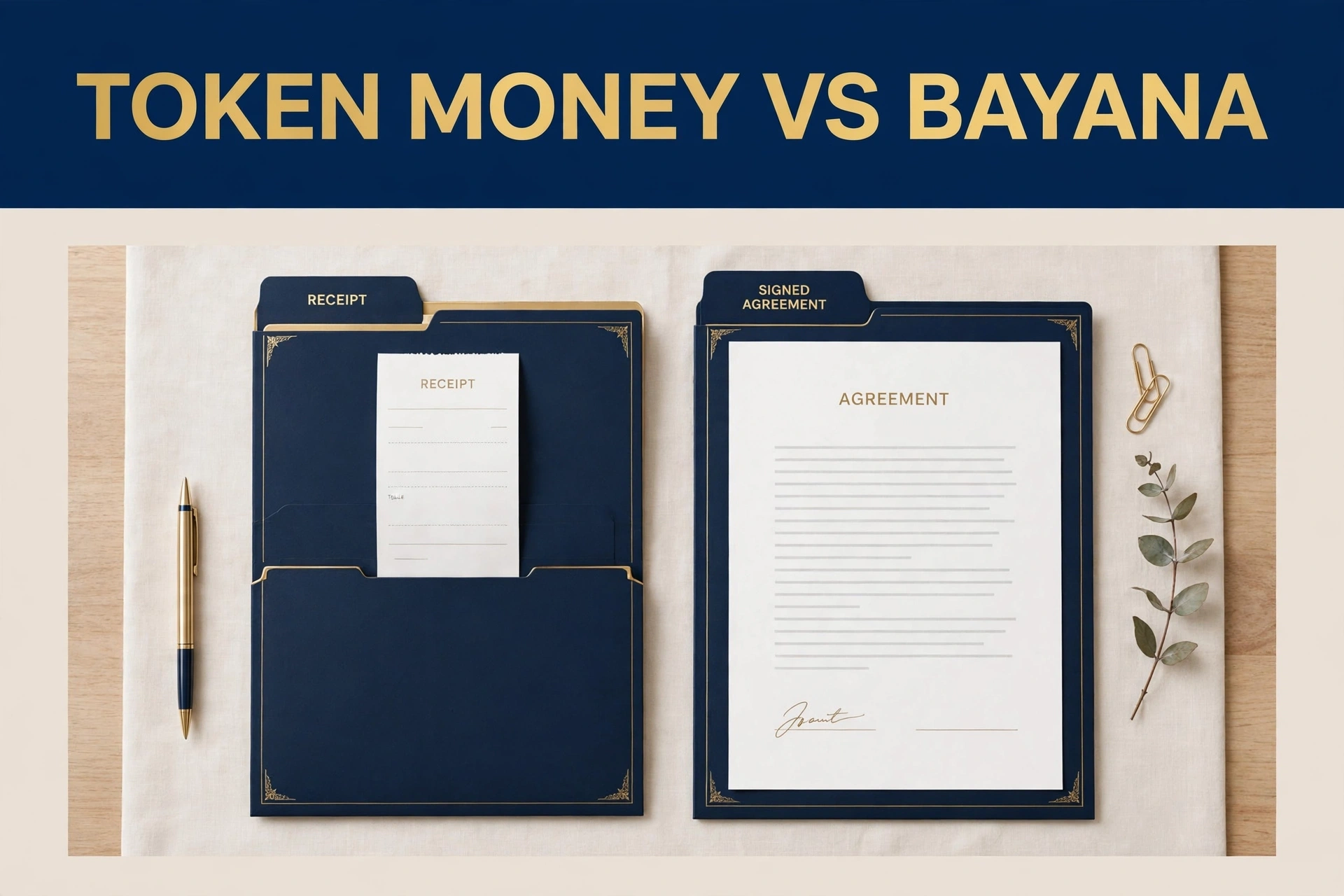
In a property deal in Pakistan, two payments usually come before the final registry: token money and bayana. Buyers often use the two words as if they mean the same thing, and dealers sometimes do too. They do not. Understanding the difference between token money and bayana matters because each payment carries a different level of commitment, a different kind of paper, and very different consequences if the deal falls through.
The short version: token money says “I am interested.” Bayana says “I am buying, on these written terms.” This article explains what each one is, how they differ, what a proper bayana agreement should state, and what to check before you pay either one.
What Token Money Means
Token money is the small, early payment a buyer gives to show serious interest in a property and to ask the seller to stop negotiating with other buyers for a short period. It usually comes first, right after the price has been discussed in principle but before the full terms of the sale have been written down.
Token money is often paid against a simple receipt, or sometimes against no paper at all beyond a verbal understanding. That informality is exactly where the risk sits. If the receipt does not say what happens when the deal fails, recovering the money can turn into an argument about what was promised. That is why our earlier guide on whether token money is refundable stresses one point above all others: the refund depends on what was written down, and on whether the token was conditional or confirmed.
A conditional token is tied to a check the buyer still has to complete, such as verifying the ownership record. If that check fails, the buyer normally expects the token back. A confirmed token, given after the buyer has already checked the property, is much harder to recover if the buyer simply changes their mind. Either way, the distinction only helps you if it is written on the receipt before you pay.
What Bayana Means
Bayana is the larger advance payment that locks in the deal on written terms. It normally comes after the token stage, once the buyer has checked the property and both sides are ready to commit. Bayana is paid under a bayana agreement, also called an agreement to sell or iqrar nama, which is normally prepared on stamp paper and signed by the buyer, the seller, and two witnesses.
The bayana agreement records the agreed price, the amount already paid, the balance still due, the last date for completing the registry, and what happens if either side backs out. That written record is what gives bayana its weight. A verbal promise is difficult to prove; a signed agreement can be shown to a court if either side breaks the deal.
One thing many buyers get wrong: a bayana agreement does not make you the owner. Ownership passes only when the sale deed is signed and registered. Until then, the agreement is a promise to complete the sale, backed by the money already paid and the penalty terms written into it. That is also why bayana should only follow document checks, not replace them: ownership does not pass until registry is complete, and a bayana agreement cannot cure a defective title.
Token Money vs Bayana: The Key Differences
| Token Money | Bayana | |
|---|---|---|
| Stage | First step, when interest is shown | Later step, when the deal is agreed |
| Purpose | Holds the property briefly while checks are done | Locks in the sale on written terms |
| Size | Small, relative to the price | A substantial part of the price |
| Paper | Often only a receipt, sometimes nothing written | A signed bayana agreement on stamp paper, with witnesses |
| Time window | Short, days rather than weeks | Longer, up to the agreed registry date |
| If the buyer backs out | Refund depends on the receipt wording and whether the token was conditional | Usually forfeited, if the agreement says so |
| If the seller backs out | Token is normally returned, but hard to enforce without paper | Agreement may require the seller to return double the bayana, if that clause is written in |
Notice the pattern in the last two rows: the consequences are not fixed by law in the abstract. They are fixed by the document you signed. Two deals that look identical can end very differently because one receipt was silent and the other was specific.
What a Bayana Agreement Should State
Before signing, check that the agreement covers each of the following. If any item is missing, ask for it to be added before you pay:
- The full names and CNIC numbers of the buyer and seller, and the exact property details, including plot or house number, area, and boundaries.
- The total agreed price, the bayana amount paid, how it was paid, and the balance remaining.
- The last date for paying the balance and completing the registry.
- What happens if the buyer defaults, and what happens if the seller defaults, including any double-bayana clause.
- A statement from the seller that the property is free of loans, court cases, and unpaid dues, as far as the seller declares.
- The signatures of both parties and two witnesses, with their CNIC details.
Do not sign a blank or half-filled agreement, and do not accept a verbal assurance that a missing clause “will be sorted later.” Once money has changed hands, your leverage to fix the paper is gone.
What Happens If the Deal Falls Through
If the buyer backs out after bayana, the usual outcome under a standard agreement is that the buyer loses the bayana. If the seller backs out, many agreements require the seller to return the bayana plus an equal amount. Neither outcome is automatic. Both depend on the exact clause in the signed agreement, and on whether the defaulting side’s failure can be proved.
At the token stage, the position is weaker for both sides. A buyer who paid cash against no receipt may struggle to prove the payment at all. A seller who accepted a token and then sold to someone else may face a claim, but the buyer still has to prove the token, its terms, and the seller’s breach. This is why the cheapest protection in any deal is also the simplest: get the terms in writing before the money moves, and pay through a traceable channel such as a bank payment or pay order, keeping the receipt and the bank record together.
Before either payment, it is also worth confirming the property itself. Check whether the property has court cases against it, verify the seller’s ownership record on the PLRA’s online land record portal, and match the seller’s name on the record with the CNIC of the person signing. A bayana agreement signed by someone who cannot prove ownership is paper without a foundation.
Before You Pay: A Short Checklist
- Confirm the seller’s identity and ownership record before any payment, not after.
- Decide, in writing, whether the token is conditional on a check or confirmed.
- Write the refund and forfeiture terms on the token receipt itself.
- Read the full bayana agreement, including the default clauses, before signing.
- Pay through a traceable channel and keep the receipt with the bank record.
- Never hand over the full bayana before the agreement is signed by both sides and witnessed.

Common Mistakes Buyers Make
First, treating a token receipt as if it were a bayana agreement. A receipt proves a payment; it does not record the full sale terms. Second, paying a large amount as “token” to show seriousness, without realising that a larger token is harder to recover if the deal fails. Third, signing a bayana agreement without reading the default clause, then discovering too late what backing out actually costs. Fourth, skipping the ownership and court-case checks because the deal “looks genuine” or because the seller is in a hurry. Urgency is not evidence of title.
The Bottom Line
Token money and bayana are two different stages of the same journey. Token money buys a short pause while you check the property. Bayana buys a written commitment to complete the sale on agreed terms. Keep the two stages separate, keep every term in writing, and never let the size of the payment run ahead of the strength of the paper behind it.
If you are buying a commercial property and want help checking the documents before you pay a token or sign a bayana agreement, contact Saeed Property Advisors in Sheikhupura and we will walk through the checks with you.
Disclaimer: This article is general information about property transactions in Pakistan, not legal advice. For your specific transaction, consult a qualified lawyer before signing any agreement or making any payment.