

Is Token Money Refundable in Pakistan Property Deals?
When you pay token money on a property in Pakistan, you are usually paying a small advance to show serious intent and to ask the seller to hold the property while you complete your checks. Whether that money comes back if the deal falls through is the question buyers ask most — and the honest short answer is: it depends on what was written on the receipt.
There is no single rule that makes every token refundable or every token forfeitable. In practice, the refund turns on three things: whether the token was conditional or confirmed, who caused the deal to collapse, and what the written receipt actually says. A verbal promise, however confident it sounded at the time, is very hard to prove later.
The Short Answer
If your receipt says the token is refundable on failed verification, and verification genuinely fails, you have a strong basis to ask for it back. If your receipt says the token is non-refundable after a stated deadline, and you simply change your mind after that deadline, the seller will usually keep it. Everything in between — the seller backing out, a hidden dispute surfacing, a deadline slipping by a day — is decided by the exact wording both sides signed.
That is why the safest time to protect a refund is before you pay, not after the deal breaks down.
What Token Money Actually Is
Token money is the first, smallest advance in a property deal. It is not the bayana, which is the larger part-payment that usually follows once both sides are committed, and it is not the full sale price. Its usual purpose is narrow: to reserve the property for a short, stated period while the buyer verifies ownership and documents and arranges the next payment.
Because the amount is small relative to the property price, buyers often treat it casually — a quick cash handover, a rough slip of paper, no discussion of refund terms. That casualness is where most token disputes begin.
Conditional Token vs Confirmed Token
Pakistani property practice generally recognises two kinds of token, and confusing them is the most common refund mistake.
| Feature | Conditional token | Confirmed token |
|---|---|---|
| Purpose | Hold the property briefly while the buyer checks and decides | Confirm a firm commitment to proceed to bayana |
| Refund position | Usually refundable if the deal does not proceed on the stated conditions | Usually non-refundable if the buyer backs out after the deadline |
| Typical next step | Verification, then either bayana or a refund | Bayana within the stated period |
| What must be written | The conditions that trigger a refund, and the deadline | The bayana deadline and what happens if either side backs out |
A conditional token only protects you if the conditions are written down. “Subject to verification” on a receipt means little unless it says verification of what, by whom, and by when. A confirmed token only binds the seller if it also states the seller’s side of the bargain — for example, that the seller will not show the property to other buyers during the token period.
When Is Token Money Refundable? Four Situations
1. The buyer backs out without a stated reason. With a confirmed token past its deadline, the seller will usually treat the token as forfeited, and that is the outcome most written receipts provide for. With a conditional token still inside its period, the buyer can usually claim a refund under the stated conditions.
2. Verification fails. This is the strongest refund case for a buyer. If the property ownership check shows the seller is not the recorded owner, or a court case against the property surfaces that was not disclosed, a receipt that makes the token “subject to verification” supports a refund. Keep the verification evidence — it is what turns a claim into a provable one.
3. The seller backs out. If the seller accepts a better offer or withdraws the property during the token period, the buyer should get the token back. Some written agreements go further and provide that the seller pays an agreed penalty in this situation, but that only applies if it was written into the receipt or agreement before payment — it is not an automatic right.
4. The deadline passes without either side acting. This is the grey area that causes the most arguments. If the buyer neither pays the bayana nor asks for an extension before the deadline, the seller may treat the token as lapsed. If the seller delayed verification or withheld documents, the buyer may argue the deadline should not count against them. Either way, the written deadline — and any written extension — decides it.
What Your Token Receipt Must Say
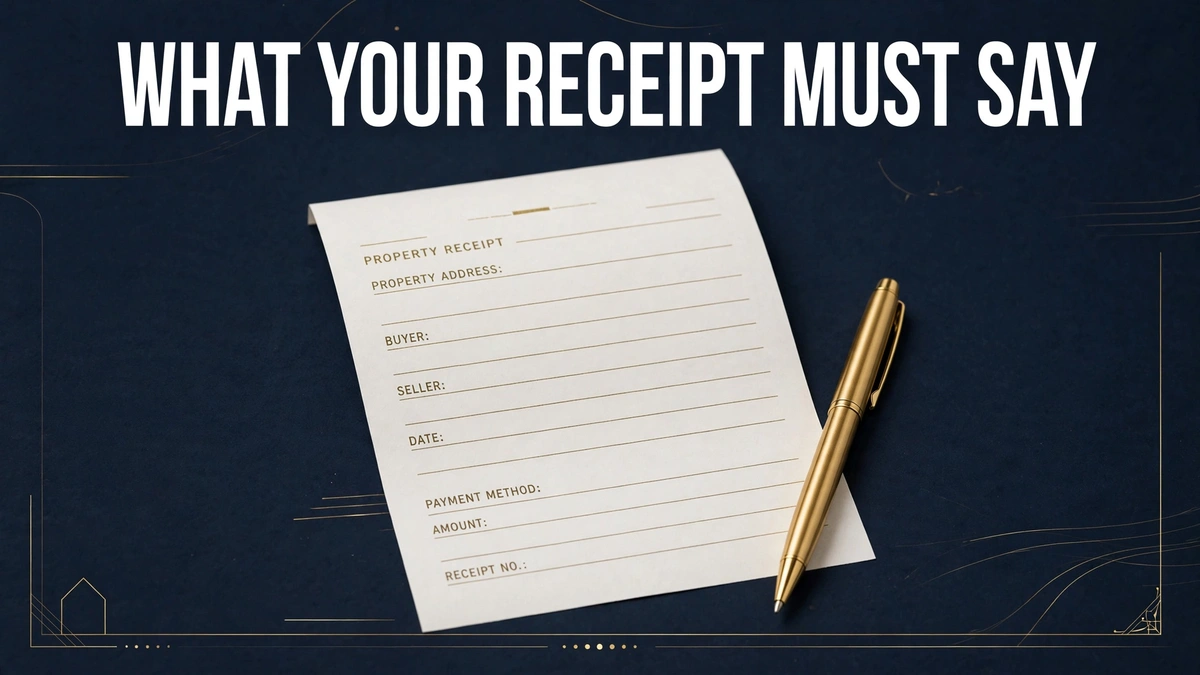
Before handing over any token, make sure the signed receipt covers these seven points. If any one is missing, ask for it to be added in writing before you pay.
- The exact property — plot or house number, size, and location as it appears in the record, not just a street name.
- Buyer and seller names exactly as they appear on their identity documents.
- The token amount and payment method — cash, cheque, or bank transfer, with a reference where one exists.
- Whether the token is conditional or confirmed, stated in those words.
- The refund conditions — precisely what triggers a refund and what triggers forfeiture.
- The deadline — the date by which verification or bayana must happen, and what happens the day after.
- Signatures of buyer, seller, and witnesses, with the date and place of signing.
A receipt that says only “token received” proves that money changed hands. It does not prove what either side promised about giving it back.
Pay in a Way You Can Prove
Paying through a banking channel creates a record that cash cannot: the amount, the date, and the recipient are all traceable. If you do pay cash, insist on a signed receipt at the same moment, in front of witnesses, and photograph it immediately for your own record. Never hand over a token on a purely verbal understanding, and never let the receipt stay “to be written later”.
Keep the token modest until verification is complete. The token’s job is to hold the property, not to prove how serious you are — a larger token only increases what is at stake if the deal breaks down, without improving your legal position. Increase the advance only once the documents have been checked and the next stage is genuinely ready.
If the Seller Refuses a Refund
Start with a written request, not another argument. State the receipt’s refund wording, the reason the deal failed, and the evidence — for example, the record showing a title problem. Give a short, reasonable deadline for repayment in writing, and keep a copy of everything you send.
If that fails, a property dealer who handled the transaction can sometimes mediate, and a lawyer can advise whether the receipt supports a formal claim. A receipt with no refund wording at all is a much weaker basis for a claim than most buyers expect.
Four Token Mistakes Buyers Keep Making
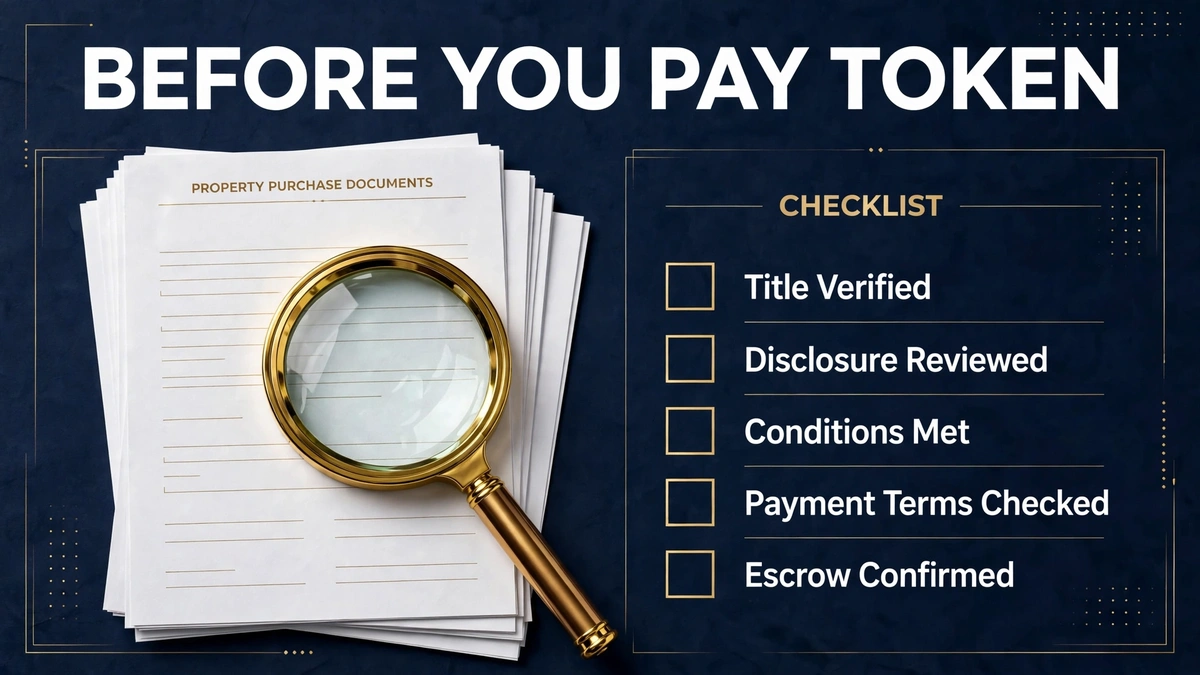
Paying before any verification. The token should buy you time to verify, not replace verification. Check the record first where you can — see our guide to verifying property documents — or make the token expressly conditional on that check.
Accepting a blank or half-filled receipt. A receipt with the refund line left blank will be read against the buyer in a dispute, not in their favour.
Missing the deadline silently. If you need more time, get a written extension before the deadline expires, even if it is only for a few days.
Confusing token with bayana. Paying a token does not give you ownership, possession, or a right to sell the property onward. Only the later stages — bayana, registry, and intiqal — move ownership, and each has its own documents.
Bottom Line
Token money in Pakistan is refundable when the written receipt says it is, and forfeitable when the written receipt says it is not. The conditions, the deadline, and who caused the failure matter more than what was said in conversation. Get the refund terms in writing, keep the token small until verification is done, pay in a traceable way, and never let a deadline pass without a written extension.
If you are about to pay a token on a commercial property and want the documents checked first, contact Saeed Property Advisors — we can walk through the record and the receipt wording with you before any money changes hands.
Disclaimer: This article is general information about property practice in Pakistan, not legal advice. Token, bayana, and refund terms depend on the exact wording of your receipt or agreement and on the facts of your case. For a disputed or high-value transaction, consult a qualified property lawyer before acting.
Source: PLRA’s online land record portal for checking ownership records before paying a token.
1 Comment
Pingback: What Is the Difference Between Token Money and Bayana in Pakistan? | Saeed Property Advisors